Engineering / Rails · Angular · S3
IndieFlow: A familiar folder experience, built over object storage.
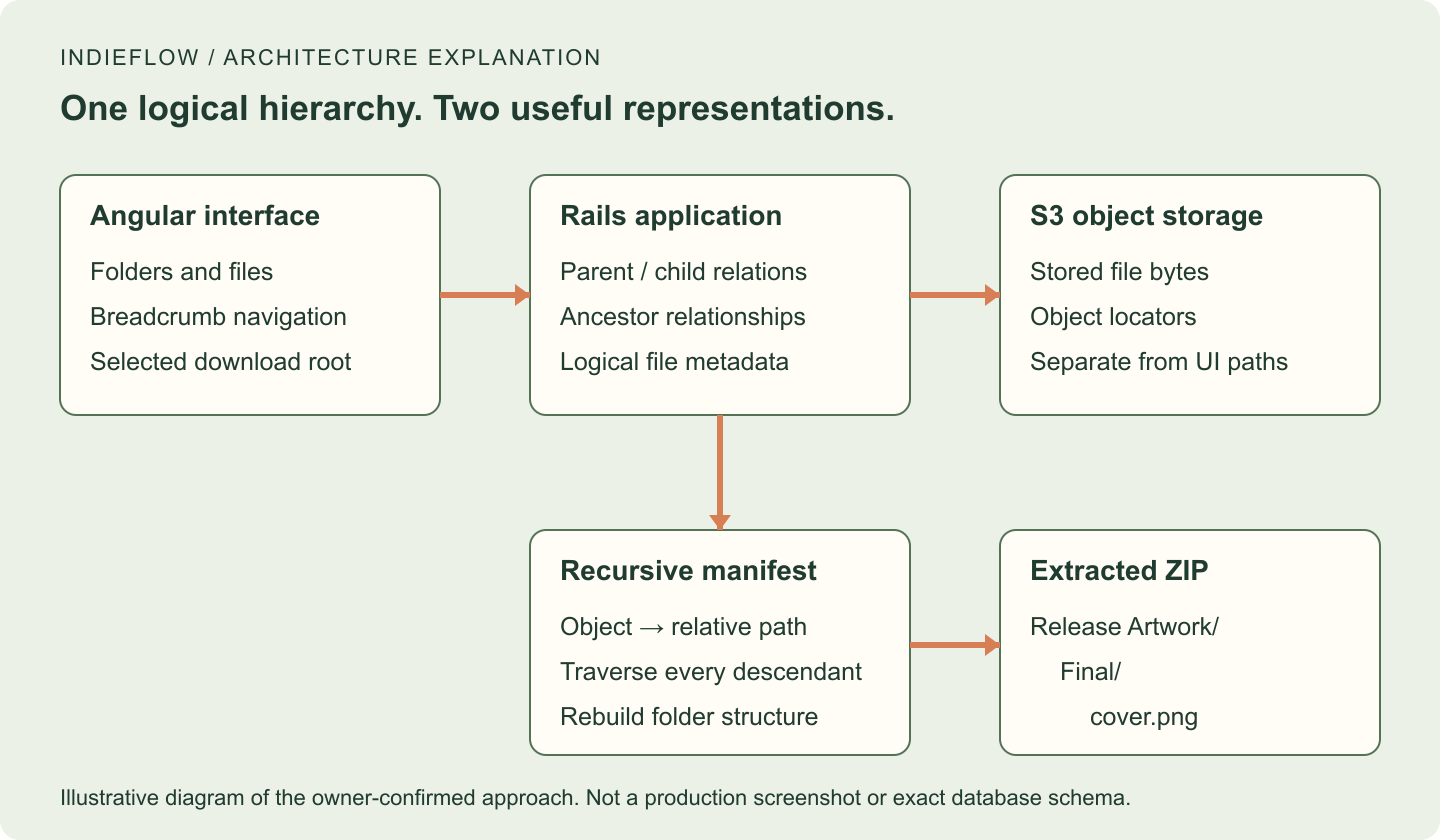
Nuo Pixel Solutions designed and developed IndieFlow’s artist file-management system with Ruby on Rails, Angular, Amazon S3 and recursive ZIP downloads that preserve the hierarchy shown on the web.
Nuo Pixel Solutions · Engineering by Mayank · Design and technology since 2015
01 / IndieFlow
The project: artists need structure, not storage keys
IndieFlow needed a file-management experience for artists’ work. Nuo Pixel Solutions designed and developed the system with a Ruby on Rails backend and an Angular frontend, using Amazon S3 to store file data. The central challenge was to make that storage feel like a familiar folder system and preserve the same structure when a user downloaded a collection of work.
The project brief confirms nested folders, parent relationships, ancestor handling and recursive collection of files for ZIP downloads. In the web interface, an artist could work with a logical hierarchy. After downloading and extracting an archive, that hierarchy needed to remain recognizable. The engineering problem was therefore larger than retrieving a list of S3 objects: the application had to carry the meaning of the artist’s organization across the boundary between a browser and a local filesystem.
This case explains that confirmed architecture and the reasoning it requires. The model names, schema, code and example folder names below are illustrative, not excerpts from IndieFlow’s private production repository. Additional safeguards are identified as engineering recommendations. No production screenshots, performance benchmarks, exact framework versions or unverified security features are claimed.
02 / IndieFlow
Two structures with different responsibilities
The user-facing folder tree and the object store serve different purposes. The tree expresses how people organize work: a project contains a folder, that folder contains another folder, and files belong at particular points in the hierarchy. Object storage preserves the bytes under object keys. The application connects those two representations.
For ordinary S3 general-purpose buckets, keys occupy a flat namespace; slashes and prefixes can suggest folders, but they do not create the same directory model as a traditional filesystem. That technical distinction is documented by AWS. IndieFlow’s project brief identifies the application-maintained hierarchy as the basis of its folder experience.
Decoupling the logical path from the storage locator is the important design move. A file can have a stable object reference while its displayed name or parent changes. The interface can show an artist-friendly location without exposing a storage key. The archive builder can then reconstruct a readable path from the logical hierarchy instead of exporting the internal object names. This is an abstraction with real behavior, not merely a visual imitation of folders.
03 / IndieFlow
An illustrative relational model
A minimal explanation uses three conceptual entities: a workspace or project boundary, a folder and a stored file. A folder has a name and an optional parent reference to another folder. A stored file belongs to a logical folder and carries metadata such as its display name and storage locator. These names describe the architecture; they are not a claim about the exact tables used in IndieFlow.
The self-reference is the key relationship. One folder can have many child folders, and each child points to its parent. A root folder has no parent within the selected hierarchy. Rails supports self-referential associations, which makes this relationship straightforward to express at the application-model level. A parent column is only the beginning, however: the application must also define what constitutes a valid tree.
Useful invariants include preventing a folder from becoming its own parent, preventing moves beneath a descendant and keeping parent-child links within the same authorized workspace. Database foreign keys and indexes can support integrity and efficient lookup, while application validation handles rules that involve more than one row. These are recommended safeguards for this model, not verified descriptions of IndieFlow’s private validation code.
Illustrative model sketch
# Illustrative Rails associations; not IndieFlow production source.
# Folder: id, workspace_id, parent_id, name
# StoredFile: id, folder_id, display_name, object_key
class Folder < ApplicationRecord
  belongs_to :parent, class_name: "Folder", optional: true
  has_many :children, class_name: "Folder", foreign_key: :parent_id
  has_many :stored_files
end
# Authorization, cycle prevention, scoped integrity, deletion policy,
# indexes and validations are intentionally omitted from this sketch.
04 / IndieFlow
Ancestors, descendants and the meaning of a path
A parent reference records one edge of a tree. A breadcrumb requires the ancestors above the current folder. A folder download requires the descendants below it. Those are different traversals over the same relationships, and confusing them can produce incorrect paths or incomplete archives.
The brief confirms ancestor handling but does not identify a particular gem or database tree extension. The concept does not depend on one. An ancestor chain can be derived by following parent links upward; descendants can be found by following child links downward. A larger implementation may use recursive SQL, a materialized path, a closure table or cached relationships where workload justifies them. Each option changes the cost of reads, moves and consistency maintenance.
A displayed path should be assembled in a defined order. For breadcrumbs, gather ancestors and reverse the upward traversal so the root appears first. For a download, define the selected root and build every archive entry relative to it. That boundary matters: downloading one project folder should not accidentally reproduce unrelated ancestors or expose internal account organization in the ZIP.
05 / IndieFlow
Angular and Rails share a hierarchy contract
The Angular frontend presents the working model; Rails owns the persistent relationships and the operations that change them. A clear contract between the two is essential. The interface needs stable identifiers, readable names, a current location and enough information to render the next level. It should not have to infer ownership or rebuild the authoritative hierarchy from S3 key strings.
For a system of this kind, an immediate-children response can keep navigation focused, while breadcrumbs provide context above the current folder. The exact endpoint names and payloads are not supplied, so none are presented as actual IndieFlow API routes. The important architectural distinction is between loading what the current view needs and downloading a full recursive tree for a separate operation.
The frontend should also communicate asynchronous state clearly. Loading, empty results and failed requests are different conditions. A failed folder request must not look like an empty folder, and a failed archive build must not look like a completed download. These interaction recommendations connect the user’s mental model with the backend’s real state without requiring the artist to understand storage mechanics.
06 / IndieFlow
Recursive collection: visit the entire selected subtree
The owner’s brief identifies a recursive approach to gathering folders and files. Starting from a selected folder, the traversal collects its files, visits each child folder and continues until every descendant has been considered. The result is a manifest describing which stored objects belong in the download and which archive-relative path each should receive.
The traversal must carry context. A stored object’s key alone is insufficient to produce a user-facing path. The current relative directory and each child’s display name determine where the file appears in the archive. This is what allows the extracted ZIP to resemble the hierarchy shown in the application.
A simple recursive function is useful for explaining the idea, but deep trees can exceed a language stack and repeated per-folder queries can become expensive. An explicit stack, batched child loading or an appropriate database query strategy can address those concerns. A visited set and depth or item limits provide additional protection if invalid data reaches the traversal. These are engineering considerations for this approach; the case does not invent the exact optimization used in production.
Illustrative recursive collection
# Language-neutral pseudocode; not runnable production code.
collect(folder, relative_path, visited):
  authorize(folder)
  reject_if_seen(folder.id, visited)
  visited.add(folder.id)
  manifest.add_directory(relative_path)
  for file in authorized_files(folder):
    path = safe_join(relative_path, validated_name(file))
    manifest.add(object_ref: file.object_ref, archive_path: path)
  for child in authorized_children(folder):
    collect(child, safe_join(relative_path, validated_name(child)), visited)
# A production builder also needs bounds, collision rules,
# consistency policy, byte-transfer handling and cleanup.
07 / IndieFlow
The ZIP manifest preserves the artist’s organization
The manifest is the bridge between metadata and bytes. Each entry pairs an authorized stored object with a safe relative path. For example, an internal object key can be exported as “Release Artwork/Final/cover.png” because the application knows which folder contains it and which ancestors exist beneath the selected download root.
Separating manifest construction from byte retrieval has several benefits. The application can inspect the intended paths, detect collisions and determine whether the selection is empty before starting a long transfer. It can also record the expected item count and handle errors explicitly. A manifest need not be a particular database table; it can be an in-memory or persisted representation chosen for the job size.
Empty folders require a deliberate decision. If the product promises to preserve them, the archive must include directory entries rather than only files. If empty folders are intentionally omitted, the interface should not imply an exact structural copy. Likewise, duplicate filenames in the same logical directory need a defined policy. Silent overwriting would violate the user’s expectation that downloading a collection preserves their work.
| Stored object reference | Archive-relative path |
|---|---|
| object-a | Release Artwork/Final/cover.png |
| object-b | Release Artwork/Drafts/cover.png |
| Explicit empty directory | Release Artwork/References/ |
08 / IndieFlow
Correctness at the storage boundary
The archive builder eventually retrieves the object bytes identified by the manifest. That operation needs to distinguish the logical file record from the object that currently exists in storage. A database record can outlive a failed upload or a deleted object, so successful hierarchy traversal does not guarantee that every byte transfer will succeed.
For a robust implementation, missing objects and interrupted transfers should produce a clear failure or an explicitly documented partial-result policy. A success message should never conceal missing work. If files can change during export, the product should define whether a download represents the selection at request time, at job start or as each object is read. Object versioning or captured metadata can support stronger consistency where required, but the project brief does not establish which mechanism IndieFlow used.
Storage access should remain server-controlled. A client-submitted object key or archive path should not be accepted as proof that a user may download it. The server should resolve the authorized logical selection and derive the storage references itself. This is a recommended boundary for an artist file-management system, not an unsupported claim about a particular authentication implementation.
09 / IndieFlow
Archive paths need their own safety rules
Names that are harmless as interface text can be unsafe or ambiguous as ZIP paths. Absolute paths, parent-directory segments and embedded separators should be rejected or normalized through a well-defined policy. A folder name should not allow an archive entry to escape the selected root when extracted. Path generation should therefore be a dedicated step, not raw string concatenation of untrusted labels.
Cross-platform behavior also matters. Windows, macOS and Linux differ in reserved names, case handling and allowed characters. Two distinct web names may collide when extracted on a case-insensitive filesystem. Unicode normalization can create another class of apparent duplicates. A production policy should preserve recognizable names while resolving or rejecting conflicts consistently.
The original names and internal identifiers can remain distinct from the safe exported names. If the application transforms a name, the behavior should be predictable and understandable to the user. These are recommendations for dependable archive output. They explain the technical difficulty of preserving a virtual hierarchy without asserting that every listed edge case was documented in IndieFlow’s implementation.
10 / IndieFlow
Large exports: memory, time and operational limits
An archive can contain many small files, a few very large files or both. Each pattern stresses a different resource. Holding every object in memory is unsuitable once total content grows beyond a modest size. Repeating database queries for every descendant can become costly even when the bytes themselves are small.
The appropriate delivery strategy depends on workload and hosting. Options include a bounded streaming pipeline or a background job that writes a temporary archive and exposes a controlled download after completion. The brief does not identify a queue library, ZIP gem or temporary-storage arrangement, so the case intentionally avoids naming one as a production fact.
Whichever approach is selected, the engineering review should consider maximum item count, total bytes, duration, cancellation, cleanup and retry behavior. Temporary files should have a lifecycle. A retry should not produce duplicate work indefinitely. Progress should describe actual state rather than a fictional percentage. These decisions make the difference between a demonstration that exports a sample folder and a service that remains understandable when a real artist’s collection is much larger.
11 / IndieFlow
A focused validation strategy
The most valuable tests for this architecture follow the user-visible promise. Create a hierarchy containing several levels, repeated filenames in different folders and an empty directory. Build the download, extract it in an isolated location and compare the relative paths and file contents with the intended manifest. That checks the contract end to end rather than merely asserting that a recursive function returned an array.
Additional recommended cases include a root-only selection, a deeply nested branch, a missing storage object, a rejected cross-workspace link and an attempted cyclic move. Archive-path tests should cover parent-directory segments and collisions. Failure tests should verify that the interface does not announce a complete archive when data is missing.
These are proposed validation criteria for the architecture, not a claim that we have access to IndieFlow’s test suite or measured results. No repository has been supplied for this public case. Keeping the examples explicit allows a prospective client to assess the engineering reasoning while respecting the boundary between a case-study explanation and a production-code audit.
12 / IndieFlow
What Nuo Pixel Solutions delivered, and why it matters
The confirmed scope combines design and implementation: an Angular file-management experience, a Rails backend, an application-maintained hierarchy over S3 and recursive ZIP downloads that reproduce the visible folder organization. The distinctive achievement is the continuity of that organization. The user works with meaningful folders in the browser and receives the corresponding structure after extraction.
This is a useful example of a broader capability. Complex web applications often require a familiar interface over a very different underlying system. The quality of the result depends on the model, relationships, failure behavior and data transformations as much as on the screen design. A folder icon alone cannot provide a trustworthy filesystem-like experience.
For a similar project, discovery should establish ownership boundaries, expected dataset size, collaboration rules, the export contract and hosting constraints before committing to an architecture. Nuo Pixel Solutions can connect UI/UX design, Rails or other backend development, frontend engineering, integrations, deployment and maintenance. The IndieFlow case shows how we approach a concrete technical problem from the user’s workflow through to the structure of the downloaded data.
13 / IndieFlow
Technical references and scope of this explanation
The project facts come from Nuo Pixel Solutions’ owner-provided brief. The official references below explain platform behavior; they are not evidence of access to IndieFlow’s private code. AWS documents the flat object-key namespace and prefix-based organization of general-purpose S3 buckets. Rails documents self-joins for relationships in which records refer to other records of the same model.
The illustrative schema and traversal deliberately omit production-specific concerns such as the exact authorization framework, storage client, database engine, background-job adapter and ZIP library. Those choices must be validated against an actual codebase and workload. The case distinguishes a confirmed project approach from optional implementation safeguards so the explanation remains useful without inventing details.
Practical questions
IndieFlow case study FAQs
Why not use the S3 key as the user’s folder path?
A storage key identifies an object. The application’s folder relationships express the artist’s organization. Keeping those responsibilities separate lets the system construct readable paths without exposing internal storage names.
How does a parent reference represent nested folders?
Each folder points to another folder as its parent. Following those links upward gives ancestors; following child relationships downward gives descendants. Integrity rules are needed to prevent cycles and invalid cross-boundary links.
How does the ZIP retain the web folder structure?
The recursive collection builds archive-relative paths from the logical hierarchy. Each stored object is written to its corresponding path, so extraction recreates the selected organization.
Are the model and code examples actual IndieFlow source?
No. They are clearly labeled explanatory examples. The confirmed stack and approach come from the owner’s brief; exact production models, libraries and optimization details have not been supplied.
Can Nuo Pixel Solutions build a similar custom platform?
Yes. Our capabilities include UI/UX, custom web applications, Rails, Angular, other backend/frontend stacks, systems integration, deployment and maintenance. Scope and architecture follow the actual workflow and constraints.
Nuo Pixel Solutions / Since 2015
Build a platform around your real workflow.
Tell us about the users, data relationships, integrations and operational constraints your application needs to handle. We can connect product design with backend and frontend engineering, deployment and ongoing maintenance.