Explore the sections in this guide
An application can look convincing before it is dependable. A generated interface may accept a form, display a dashboard and walk through a happy path, yet still lack the rules that make those actions safe for real customers. The gap becomes visible when two people edit the same record, a payment callback arrives twice or a user requests information belonging to another account.
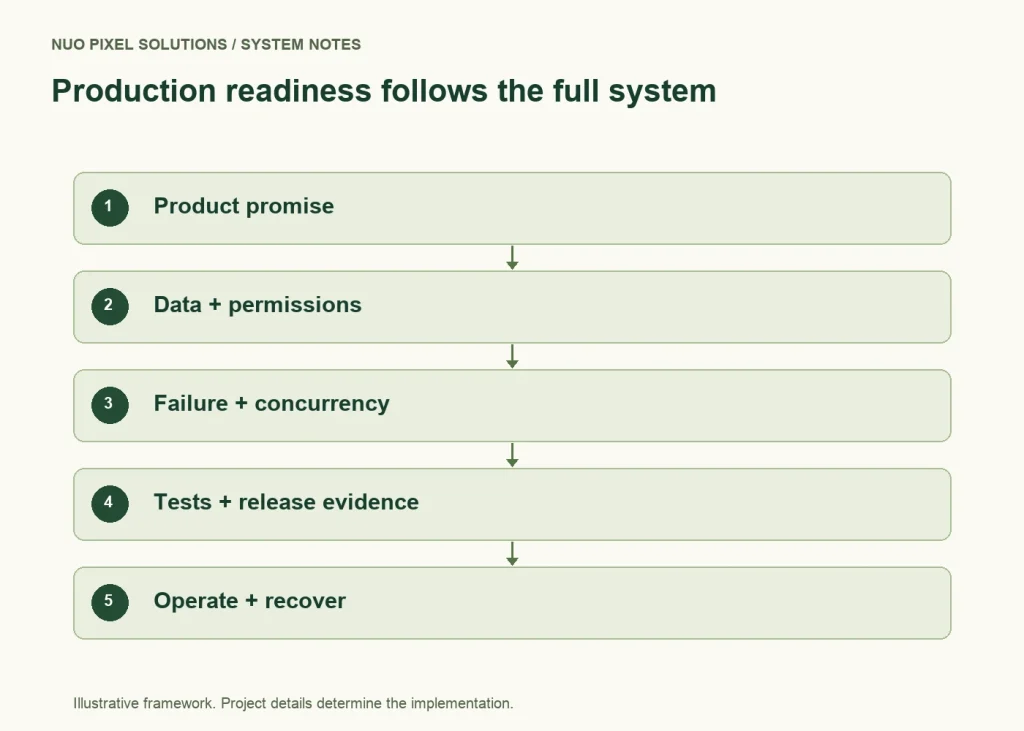
We see production readiness as a collection of explicit decisions about data, permissions, failure and operation. It is not a badge attached to the tool used to write the first version. AI-assisted work can be part of a sound engineering process, but attractive output does not replace that process. At Nuo Pixel Solutions, we assess what a system promises and trace those promises through the interface, backend and operating environment.
This guide explains how we would review a demonstration before exposing it to customer data. The examples describe an illustrative project-management application, with organizations, members, projects and files. The same questions apply to CRMs, quotation platforms and internal business tools.
Define the promise before reviewing the code
Start with the tasks a customer is expected to complete. A project workspace might promise that members can upload files, managers can invite colleagues and each organization sees only its own work. Those statements imply ownership, role checks, storage rules and lifecycle behavior. A clickable screen proves little unless the underlying system consistently enforces them.
We write acceptance scenarios in business language. A removed member must lose access to existing files. A failed upload must not appear as a completed asset. An invitation must not grant a role the sender is not allowed to assign. These scenarios provide a more useful review structure than asking whether the application “looks finished.”
We also record what the first release deliberately excludes. Offline editing, public sharing or complex billing may be unnecessary initially. Explicit exclusions keep a readiness assessment focused and prevent prototype shortcuts from being mistaken for supported behavior. The release should make a smaller set of promises reliably rather than imply a wider product through its interface.
Establish a coherent data model
A demo often stores whatever shape the screen needs at that moment. Production data must survive changes in screens and business rules. We identify entities, relationships and ownership before adding more interface features. In our example, projects belong to organizations, memberships connect users to organizations and file records belong to authorized projects.
The model needs constraints as well as columns. Required relationships, uniqueness and valid state transitions should be enforced at an appropriate layer, including database constraints where possible. A frontend dropdown cannot guarantee that an API request contains an allowed value. A record with no valid owner should not enter the system simply because the interface usually sends the correct identifier.
We review deletion and retention behavior explicitly. Removing a project may affect files, comments, activity and exports. The system needs a deliberate choice between immediate deletion, a recovery period and retained audit information. That choice should reflect the product and its obligations, rather than emerge accidentally from an ORM cascade.
Separate identity from authorization
Authentication answers who the requester is. Authorization answers what that requester may do to a particular resource. A login screen, a token and a hidden navigation item do not establish the second property. Every sensitive backend action needs a check against the authenticated user, organization and resource. OWASP: authorization guidance.
We examine direct-object requests. If a user changes a project identifier in a URL or request body, does the server fetch the record inside the user’s authorized scope? A generic lookup followed by an incomplete UI check can expose another customer’s data. We prefer a clear authorization policy that is exercised consistently across pages, APIs, exports and background jobs.
Membership changes must propagate to subsequent requests. Long-lived links and cached permissions need defined behavior when a person leaves an organization. Administrative access also needs boundaries and an audit trail. A support role should not inherit unlimited data access simply because the first prototype treated every staff account as an administrator.
Validate requests at the system boundary
Generated forms commonly include client-side validation because it is visible and easy to demonstrate. The server must independently validate types, allowed values, lengths and relationships. Browser checks improve feedback; they do not make a request trustworthy. We also limit request sizes and apply file-specific rules before accepting uploads.
Validation should produce errors the interface can explain. A field-level error belongs near the affected field, while an authorization failure or unavailable dependency needs a different response. Returning a generic success object after catching every exception hides defects and misleads the user about whether their work was saved.
We distinguish validation from safe output handling. A project name can be valid text and still require escaping when rendered as HTML. A search query may be acceptable input and still need parameterized database access. Different boundaries require different controls; one broad “sanitize” helper is not an architecture.
Review dependencies and secrets
A prototype may include packages copied from examples without an understood maintenance plan. We inventory direct dependencies, lock their versions and check whether they are necessary, maintained and compatible with the deployment environment. Fewer unexplained packages make both security review and future debugging more manageable.
Secrets belong in an appropriate environment or secrets system, outside public source and client bundles. We inspect generated frontend configuration carefully: a variable name that begins with “private” does not stop a build tool from embedding its value in JavaScript. Browser-delivered code must be treated as public.
We separate development, staging and production configuration. Test accounts, permissive CORS policies, debug routes and verbose error output should not reach a public release by accident. A deployment checklist identifies required configuration without recording secret values in documentation, screenshots or chat transcripts.
Make repeated requests safe
Real networks are imperfect. A user can click twice, a browser can retry and a job queue can deliver work more than once. A demo that assumes one request equals one action can create duplicate invoices, repeated invitations or conflicting file records. We identify operations where repetition has a business consequence.
For those operations, an idempotency mechanism can associate a retry with an existing attempt. Its scope, expiry and relationship to the authenticated account must be explicit. Database uniqueness and transactional changes often provide the final guarantee. A frontend disabled button is useful feedback but cannot enforce that guarantee.
Concurrent updates need a policy too. If two managers edit the same project, should the last write win, should the second save detect a stale version or can changes be merged? We choose around the data and user task. Silent overwriting may be acceptable for a disposable preference and unacceptable for a reviewed quotation.
Handle files as a separate subsystem
Uploads involve more than selecting an object-storage SDK. We define allowed sizes and formats, authorization to initiate and complete an upload, storage-key generation and the relationship between a file object and its database record. User-facing filenames should not become unrestricted storage paths.
An incomplete upload needs a recoverable state. The application should distinguish pending, available, failed and deleted assets, and reconcile abandoned objects. Download links need an access model, bounded validity where appropriate and a response that does not expose credentials. Private storage does not help if an unrestricted endpoint generates links for any supplied identifier.
We also examine how files are processed. Previews, parsing and archive creation may require separate workers and resource limits. A malformed or unusually large input should not exhaust the web process serving every customer. These jobs need timeouts, observable status and a failure path that the interface can communicate.
Design the states around the happy path
A loading spinner is not an entire interaction model. We inspect empty, loading, validation, partial failure, permission-denied and success states. Each should tell the user what happened and what they can do next. A failed save should preserve recoverable input rather than return the screen to an empty form.
Accessibility belongs in this review. Controls need clear names, focus must remain understandable after dialogs and asynchronous updates, and status messages should not rely only on color. Keyboard users should be able to perform the core task. Responsive layouts must accommodate real text, error messages and long filenames.
We connect these interface states to backend responses rather than inventing them independently. If the API cannot distinguish a processing job from a failed one, the frontend cannot reliably present that distinction. Production readiness is often improved by a better contract, not by another layer of visual polish.
Test the rules that could hurt someone
| Scenario | Required server behavior | Visible outcome |
|---|---|---|
| User changes organization ID | Authorize the resource within the requester’s permitted scope | No private data returned |
| Removed member uses an old link | Re-evaluate current permission | Explain that access is unavailable |
| Request is retried | Recognize the same authorized operation | One durable action, consistent response |
| Upload processing fails | Mark the file as failed; preserve useful context | Recovery guidance rather than a false success |
A useful test suite protects meaningful behavior. We prioritize organization boundaries, permission changes, duplicate prevention, important calculations and irreversible transitions. We include negative cases, such as a removed member attempting a download or an invalid state transition arriving directly through the API.
End-to-end tests should exercise a few important journeys against realistic data. Lower-level tests can cover the detailed business rules more cheaply. We avoid equating a large test count with confidence; tests that reproduce the implementation without challenging its assumptions may all pass while the product remains wrong.
Generated code deserves ordinary review, including comprehension by the maintaining developer. We ask whether the team can explain the error handling, data access and dependencies. If nobody understands why a section exists, passing tests are not enough to make it maintainable. The next incident will require reasoning about behavior that the original prompt did not anticipate.
Prepare observability without collecting everything
When a customer reports that an action failed, the team needs a way to locate the relevant request or job. We use correlation identifiers, structured logs and clear operational events. A useful record describes the operation, outcome and timing without copying secrets or unnecessary customer content.
Metrics and alerts should reflect important failure modes. A queue that is growing, repeated failed exports or an inquiry integration that has stopped delivering records can matter more than overall request volume. Alerts need an owner and an actionable response, otherwise they become background noise.
We also distinguish application errors from infrastructure limitations. A worker that lacks memory needs a different intervention from a permissions bug. The production environment should make those differences observable. A dashboard full of green indicators is unhelpful if it does not cover the operations customers depend on.
Rehearse release and recovery
A release needs a known path from reviewed code to the running environment. We document build requirements, environment variables, migrations and worker processes. Database changes should be considered alongside compatibility with the old and new application versions, especially when deployment cannot be instantaneous.
A backup is useful only if restoration is understood and feasible. We identify what is backed up, how often, how long it is retained and who can restore it. Uploaded files and database records may require coordinated recovery. Rolling back application code does not automatically reverse a destructive data migration.
We rehearse a limited release where appropriate and verify the important customer journeys after deployment. The team needs a rollback decision, not simply a hope that no problem will occur. These practices can be lightweight for a small application while still being explicit and reviewable.
Decide what to retain, repair or rebuild
An assessment should not assume that all prototype code must be discarded. A useful interface, clear component system or well-modeled workflow may be worth retaining. Other areas may need focused replacement because they put business rules in the browser, mix customer scopes or depend on unmaintained packages.
We classify findings by impact and dependency. Fixing authorization before adding more screens is usually more valuable than polishing a low-risk view. A weak domain model may need correction before integrations multiply its inconsistencies. A clear sequence prevents a readiness review from turning into an unprioritized list of every possible improvement.
At Nuo Pixel Solutions, we can connect that assessment with UI/UX design, backend engineering, integration and deployment. The useful outcome is a reviewable release plan: what the application will support, which risks must be resolved first, what evidence demonstrates readiness and who will operate the result. A demo becomes a product through those decisions and the engineering that makes them dependable.
A worked readiness check: inviting a colleague
Consider a manager inviting an editor into a project workspace. The visible action is one form, but the implementation crosses several rules. We first confirm that the sender belongs to the organization and may invite the requested role. The server derives the organization from the authorized context rather than trusting an arbitrary request field. The invitation has a unique token, an expiry and a defined state.
Acceptance then needs its own checks. The token must still be valid, the organization must remain active and the resulting membership must not exceed the original invitation’s permissions. An expired invitation should provide a useful recovery route without revealing private account details. Repeating an acceptance request must not create duplicate memberships or resend unrelated notifications.
We would test the sender losing permission between creation and acceptance, an invitation being revoked and two acceptance attempts arriving together. We would also inspect the screen-reader announcement after submission and the email delivery status. These are specific, testable behaviors that connect the interface promise with backend correctness. Reviewing one ordinary feature this way often reveals more about readiness than a broad visual tour of the entire application.