Explore the sections in this guide
A website can appear in search results and still leave a visitor uncertain about the most basic question: can this company solve my problem? Adding a chatbot does not automatically fix that gap. If the underlying service information is vague, the assistant simply provides a more conversational route to the same uncertainty. We approach search visibility, site search and conversational assistance as connected parts of one information system.
At Nuo Pixel Solutions, we want a visitor to understand our capabilities, inspect relevant work and reach a useful next step without repeating the same explanation across several interfaces. That requires clear public pages, structured information, a reliable retrieval layer and deliberate boundaries around what an assistant may say or do. The objective is an accurate, usable experience; a citation in an external AI answer remains outside our control.
This guide describes a practical architecture for a business website that needs useful search, source-backed answers and a restrained inquiry journey. The examples are implementation patterns, rather than claims that a particular assistant or integration is already operating on this website.
Separate three problems before choosing technology
External discovery, internal discovery and assisted qualification are different jobs. External discovery concerns whether public pages can be crawled, indexed and understood by search systems. Internal discovery helps an existing visitor find a service, resource or answer within the website. Assisted qualification gathers enough context to route a conversation to the right person. Treating all three as a single chatbot feature makes ownership and measurement unclear.
A visitor searching for a manufacturing quotation system might need a service overview first, an explanation of file handling second and a discussion of pricing rules third. The public page should answer the broad question. Site search should retrieve the relevant sections. A conversational layer can clarify whether the visitor needs a public RFQ form, an internal estimator or an integrated ordering workflow. Only then does requesting contact information become useful.
We define the purpose of each surface before specifying its implementation. That makes a simple search result acceptable when it solves the problem, and reserves conversational behavior for questions that benefit from clarification. A business does not need a language model to return an approved delivery-policy statement.
Build an answerable content model
Useful answers start with information that has clear ownership. We organize service information around an audience, problem, scope, deliverables, dependencies, limitations and next step. A capability page should explain what the work involves, what a client must supply and which decisions remain project-specific. Case studies should distinguish actual implementation details from illustrative examples.
For a CMS, this can become a structured record with a title, canonical URL, content type, service relationships, publication status, responsible editor and review date. Approved answers can reference that record rather than copying untraceable text into a separate chatbot dashboard. The public page remains the source a visitor can inspect.
Content also needs stable boundaries. A paragraph about typical project phases must not be retrieved as a promise of a fixed delivery date. A historical case study must not override a current service policy. We attach context such as project, date, locale and audience when it affects interpretation. These small modeling decisions reduce the amount of judgment delegated to the assistant.
Keep search foundations visible in the rendered page
Important service information should be available as readable page content, with meaningful headings and crawlable internal links. Navigation, canonical URLs, indexability and sitemap behavior should agree about which page represents a topic. An answer hidden exclusively inside a chat session does not provide the same public resource as an accessible article or service page.
Google’s guidance says its established SEO practices remain relevant to its AI search features. It does not require a special AI markup format, and eligibility does not guarantee inclusion. We therefore prioritize clear public information over speculative files or labels that imply guaranteed AI visibility. Other discovery systems have their own behavior and should be evaluated separately. Google Search Central: AI features and your website.
Structured data should describe the content that people can actually see. A service entity can identify the provider and service type; an article can identify its author, image and publication date. Neither is a license to invent ratings or outcomes. We keep machine-readable statements aligned with the editorial page, including its limitations and the identity of the responsible organization.
Create an index that can be updated and explained
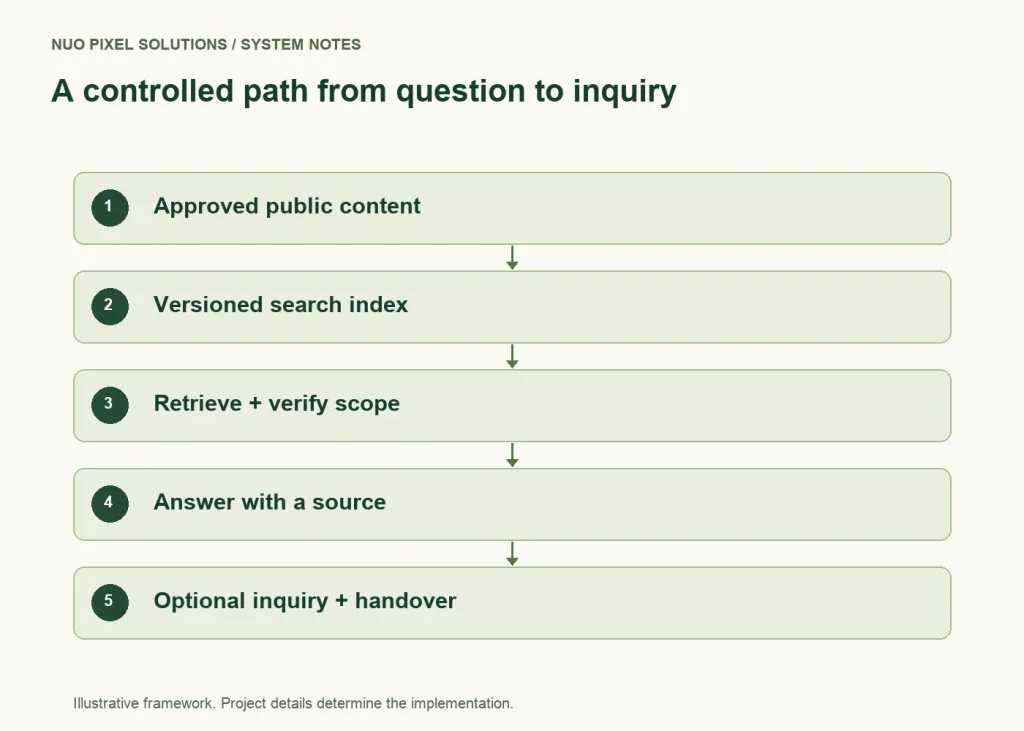
An indexing pipeline needs more than a crawler that runs occasionally. We define which published records are eligible, how revisions are detected and how removed material disappears from the index. Drafts, private documents, contact submissions and administrative pages should not become answer sources through an overly broad content export.
For each indexed section, we retain the canonical document identifier, section heading, locale, updated timestamp and a content checksum. A document version helps us detect answers built from stale text. When a page changes, a controlled update can replace its old sections rather than append duplicates indefinitely. Deletions must propagate as deliberately as additions.
We also maintain a diagnostic view. An editor should be able to inspect which source sections matched a question and why an answer was selected. Without that view, correcting a bad answer becomes guesswork. Index freshness, source ownership and removal behavior are operating requirements, not implementation details to postpone until after launch.
Choose retrieval around the questions visitors ask
Lexical search is valuable for exact product names, technical terms and identifiers. Synonym mappings can connect ordinary language with a company’s terminology. Semantic retrieval can help when a question expresses an idea without using the page’s exact wording. A hybrid system may combine these signals, but each additional mechanism needs an identifiable benefit and a way to evaluate it.
We preserve exact constraints instead of allowing broad similarity to erase them. A question about WordPress plugin maintenance should not be treated as equivalent to a general website redesign inquiry. Language, content type and service category can act as explicit filters. Identifiers and quoted phrases may deserve stronger matching than general descriptive words.
A first version can use an ordinary self-hosted search index, curated synonyms and approved answer records. A model-assisted layer is optional. If an organization later introduces embeddings or generation, we assess the model’s license, available infrastructure, privacy requirements and operational costs before adopting it. No inaccessible model or paid external API is a prerequisite for a useful search experience.
Define what an exact answer actually means
Illustrative approved-answer record. This is a proposed schema, not a live policy or an implemented chatbot.
{
  "answer_id": "accepted-file-types",
  "status": "approved",
  "source_document": "upload-guidance",
  "source_section": "accepted-formats",
  "source_version": "v3",
  "locale": "en",
  "answer_text": "Return the exact approved wording from this source.",
  "on_missing_or_stale_source": "offer_source_page_or_human_review",
  "lead_capture_required": false
}
An exact answer is appropriate when the source is controlled and the question has a stable, unambiguous response. Examples include a published contact address, accepted submission format or a documented support procedure. The system can return the approved wording directly, with a source link and a review date. It should not paraphrase a precise policy into a broader commitment.
Questions about price, feasibility and delivery time usually need qualification. A system can explain the factors involved and gather the missing context, but it should not manufacture a fixed quote from a paragraph about typical projects. We distinguish approved direct answers, source-backed explanations and questions that require human review. That distinction belongs in the interface as well as the backend logic.
Retrieval scores are not a truth meter. A strong text match does not prove that the source is current, applicable or sufficient. We combine matching with source status, scope and explicit answer rules. When those checks fail, a clear statement that the information needs confirmation is more useful than a confident sentence with an unrelated citation.
Make the conversation useful without making it compulsory
A visitor should be able to read the website, use ordinary search or open the contact page without entering a conversation. The assistant is an additional route. It needs a visible close control, keyboard access, readable messages and a way to reach source pages. Its presence should not obscure the primary content on a small screen.
Conversation can begin with a useful distinction: are you exploring a service, trying to find information or discussing a project? We then ask one question at a time when the answer changes the recommendation. A software inquiry may need a description of the current workflow. A brand inquiry may need the business name and whether an identity already exists. Unrelated questions add friction without improving the handover.
We avoid turning the assistant into a simulated account manager with imaginary certainty. It should identify its role, explain when it is using approved information and offer a human route when the question exceeds that information. The experience should feel coherent and helpful even when no generated response is available.
Gather inquiry details after providing value
A short lead form can collect a name, an email address and a brief description of the project. A service choice can remain optional. We ask for information when it helps continue the discussion, rather than forcing a visitor to reveal contact details before seeing a basic answer. A phone number, budget and detailed specification can usually wait.
Before submission, we show the visitor the information that will be sent. If a conversation summary is included, the visitor should be able to correct it. We distinguish information they explicitly provided from a summary inferred by the assistant. An inference such as “enterprise budget” must not silently become a factual CRM field.
The interface also explains what happens next: for example, that the team will review the inquiry and reply by email. Marketing subscriptions are separate choices. We apply an appropriate retention policy, restrict staff access and avoid gathering passwords, payment details or unnecessary personal information through chat. The final privacy wording needs to reflect the organization’s actual practices and applicable requirements.
Design the handover as a dependable transaction
A successful interface message should correspond to a recorded submission. We validate fields on the server, apply abuse controls and create a durable inquiry record before claiming that a request was received. If CRM synchronization happens asynchronously, the record can carry a delivery status and a retry history. A temporary integration failure should not erase the visitor’s message.
Duplicate prevention also matters. A visitor may retry after a slow response. An idempotency key can connect repeated attempts to one submission within a defined window, while still allowing genuinely separate inquiries. The backend must validate ownership and scope; a browser-generated identifier is not an authorization mechanism.
The handover record can contain the selected service, approved contact fields, visitor-confirmed summary and relevant public page references. A conversation transcript should be included only where justified and disclosed. We avoid placing contact details inside ordinary analytics events or search logs. The sales team needs useful context, while technical telemetry usually needs only a submission identifier and delivery outcome.
Keep retrieved text separate from authority
If a language model is introduced, retrieved material must be treated as information rather than instructions. A compromised page or imported document can contain text that attempts to change the assistant’s behavior. Source approval, restricted ingestion, clear instruction boundaries and output validation reduce exposure, but a prompt alone cannot make an unsafe integration trustworthy. OWASP: prompt injection prevention.
The model should not independently authorize database updates, reveal private records or send messages. Tool access needs narrow schemas, server-side permission checks and explicit confirmation for consequential actions. A support article containing an instruction to export customer information must have no power to create that permission.
We test malicious and misleading inputs as part of the system design. These include requests to reveal internal prompts, questions mixing public and private information, poisoned source sections and repeated attempts to bypass inquiry validation. We also design fallback behavior for unavailable retrieval, model errors and timeouts. Safety and reliability depend on the whole application boundary, not a claim that retrieval has eliminated hallucinations.
Evaluate answers with a real question set
Before launch, we assemble representative questions from service discussions, existing search terms and the team’s knowledge of common misunderstandings. The set includes exact factual questions, ambiguous requests, unavailable information, multilingual phrasing and questions outside the company’s scope. We record the expected source or expected refusal for each case.
Evaluation separates retrieval quality from answer quality. Did the system find the right document? Was the chosen section sufficient? Did the response preserve qualifications? Did it cite a source that actually supports the claim? For approved direct answers, we can check the returned record and wording. For open explanations, human review remains important.
We also inspect the inquiry journey. Can visitors correct their details? Does a failed submission preserve the message? Does a retry create a duplicate? Can staff understand what needs follow-up? These checks make the assistant useful as a business interface rather than merely impressive in a short demonstration.
Measure outcomes without disguising uncertainty
Useful measures include unsuccessful searches, time to a relevant result, source-link use, unanswered-question categories and completed inquiries. We distinguish a message sent to the assistant from an actual qualified inquiry. A chatbot can produce many interactions while making it harder to reach the team, so volume alone is an unreliable success measure.
We review patterns rather than turning every transcript into marketing data. Repeated questions may reveal a missing service explanation. A high rate of irrelevant matches may indicate poor synonyms or overly broad content chunks. Abandoned inquiry submissions may expose a validation problem or excessive qualification.
For external discovery, we monitor the site’s available search reporting and the business value of referred visits. We do not label every traffic change as a result of AI optimization. Search systems, competition and publishing activity can all change. A useful measurement plan states which observations are available and which conclusions remain uncertain.
A practical first release
We would begin with a controlled set of service pages, case studies and approved answers, then add transparent site search and a short inquiry path. The first release should include source links, content-update procedures, accessible controls, server-side validation and a reliable staff handover. A conversational layer can then be added where it improves clarification or navigation.
At Nuo Pixel Solutions, this work connects content architecture, interface design, backend development and maintenance. The strongest implementation is the one the business can understand and operate. Clear pages help people and discovery systems; dependable search helps visitors find them; a careful assistant helps move from information to a useful conversation. Each layer earns its place by solving a specific problem.