A website brief should help two people understand the same problem. It should not be an exam that a prospective client has to pass before a design team will speak with them. If somebody already knew every technical requirement and implementation decision, they might need a different kind of conversation.
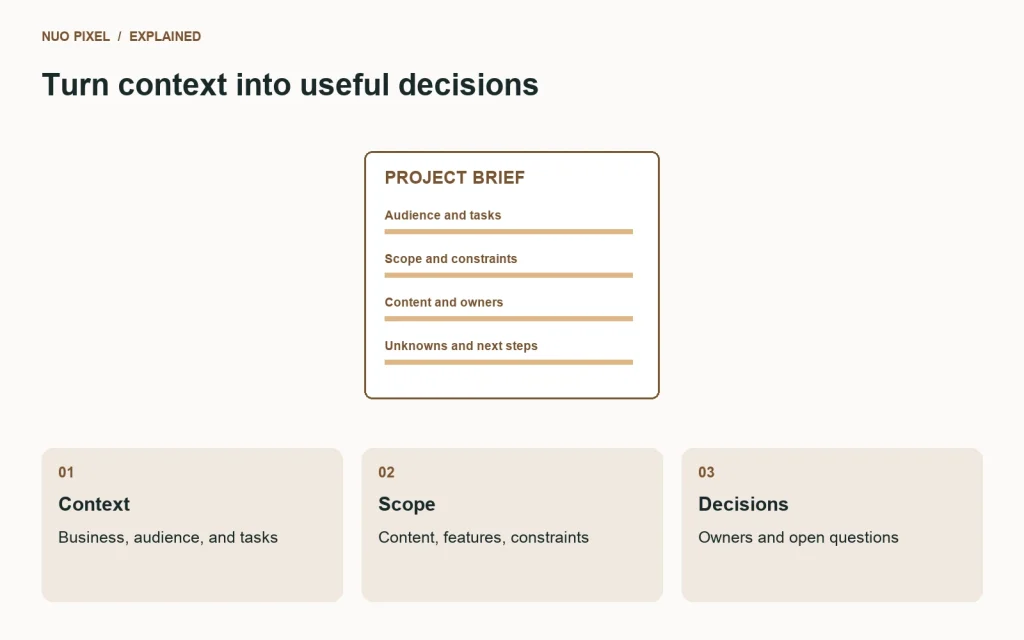
This Nuo Pixel Solutions template begins with the organization, the people the website serves, and the tasks those people need to complete. It then collects scope, content, constraints, timing, and the way decisions will be made. The accompanying editable brief includes clearly labeled sample answers so a contributor can see the expected level of detail without copying a fictional project as though it were real.
Use the template as a starting point. A small brochure website, a publishing platform, and a specialized browser tool need different follow-up questions. The purpose of the first brief is to expose useful information and uncertainty, not to pretend that every question can be settled in one form.
Describe the business in concrete terms
Begin with what the organization does, who it serves, and how people currently reach it. Use ordinary language. A description such as “We help local manufacturers prepare product documentation” gives a design team more useful context than a list of broad adjectives about innovation and excellence.
Explain the current website or alternative process. Perhaps inquiries arrive by telephone, a social profile serves as the main public presence, or staff repeatedly email the same document. These details help identify which parts of the customer journey the website should support and which work remains elsewhere.
Identify the person responsible for the brief and the people who need to contribute. A project can become difficult when commercial, content, and technical decisions arrive through unrelated channels. The brief should reveal those responsibilities early without implying that one contact must know every answer personally.
Define the visitor and the task
Describe the people who will use the website in terms relevant to their behavior. What are they trying to find out? What information do they already have? What might make them hesitate? Avoid inventing a detailed persona merely to fill a template if you have no evidence for the details.
List a few important tasks. A visitor might compare services, download a specification, find an example of relevant work, request an estimate, or use a small utility. A clear task gives design and development decisions a purpose that can be tested later.
Distinguish the visitor’s task from the business outcome. “Understand whether the service fits my project” describes a visitor need. “Receive more suitable inquiries” describes a business goal. A good website should connect the two rather than treating every visitor as a target for a generic conversion button.
For Nuo Pixel Solutions, this part of the conversation helps connect design clarity with implementation. A browser tool, article, portfolio page, and contact form may serve different immediate tasks while contributing to the same larger relationship with the studio.
Explain what is not working now
Write down specific problems with the current experience. A problem might be that service descriptions overlap, mobile navigation is difficult, the form loses entered text, or image preparation takes staff too long. Give an example when possible.
Separate observations from interpretations. “Three recent customers asked where to find the specifications” is different from “The navigation is terrible.” The observation helps the team investigate the cause. The interpretation can be a useful starting opinion, but it should not hide the evidence.
Include what already works and should be preserved. A redesign can accidentally remove a familiar workflow, a useful archive, or an effective explanation because the brief contains only complaints. Existing strengths deserve explicit consideration alongside the problems.
Do not add invented analytics to make the brief look complete. If you do not know how many people use a page, say so. A missing measurement is a question to investigate, not a blank that needs an impressive-looking number.
Set goals you can evaluate
Choose a small number of goals and define what evidence would support them. Improving the clarity of a service comparison might be checked through task-based review. Improving form reliability might be checked through controlled submissions and delivery monitoring. Increasing suitable inquiries requires a useful definition of suitable and a sensible observation period.
Keep the goals realistic for the project. A website change cannot independently guarantee sales, search positions, or operational outcomes affected by many other factors. The brief should describe the intended contribution without turning an aspiration into an unsupported promise.
Identify a baseline if one exists. It may be an existing workflow, a measured response, a set of recurring questions, or a collection of usability observations. If no baseline exists, decide what can be recorded before the project changes the situation.
Avoid using a single headline number to describe success when the experience has several important parts. A page can receive more visits while attracting a less relevant audience. A form can receive more submissions while producing less useful information. The evaluation should reflect the actual purpose of the website.
Define the scope in journeys and content
List the main pages, content types, and tools. Explain what each one needs to do. A page count alone can conceal substantial differences: a simple information page and a custom converter may each appear as one item in a sitemap while requiring very different work.
Identify shared structures. Articles may need titles, excerpts, featured images, categories, and related reading. Tools may need input validation, processing states, downloads, and instructions. These patterns help the team estimate and design reusable components rather than treating every page as unrelated.
Record important exclusions. If ecommerce, user accounts, multilingual content, or a CRM integration are outside the initial release, say so. A clear exclusion is easier to discuss than an assumption discovered after the implementation has begun.
Leave room for questions. A brief can mark an item as undecided and name the person who can help resolve it. False certainty about an integration or content workflow can create more rework than a clearly documented unknown.
Inventory the content and assets
Identify who writes, reviews, and supplies the content. List existing text, photography, logos, documents, and examples that may be reused. Confirm that the project has the relevant permissions before treating an asset as an approved public deliverable.
Distinguish a content source from publication-ready material. A long internal document may contain useful facts while still needing restructuring for a web page. A portfolio file may require approved selections and explanations rather than a direct upload of every page.
Record image and brand dependencies. An editable logo with missing fonts, photographs without confirmed usage rights, or inconsistent product names can delay a website even when the layout is ready. The brief should make those dependencies visible early.
For a blog or resource library, decide who maintains the material after launch. Long-form articles need evidence, useful illustrations, and revision ownership. A large initial collection does not remove the need to correct outdated instructions or broken downloads later.
Describe functionality without prescribing every solution
Explain the behavior you need. “Visitors should upload an image, choose a size, preview the result, and download it” is a useful functional description. “Use a particular framework” may be a genuine constraint, but it does not replace the behavior description.
List integrations and the people responsible for them. If a form must reach an existing system, identify the system and what information needs to move. Do not paste passwords, private keys, or sensitive customer records into the brief. Access should be arranged through an appropriate separate process.
Describe error and recovery expectations. What happens when an upload is unsupported, a request fails, or an external service is unavailable? These are ordinary product states, not optional polish to consider only after the successful path is built.
Identify any browser, device, language, or hosting constraints that are already known. If they are assumptions, mark them as assumptions. The team can then verify them instead of designing around a requirement that nobody actually established.
Discuss timing as dependencies, not only a date
Write down the preferred launch date and why it matters. An event, campaign, contract, or operational change may create a real dependency. A date selected only because it sounds convenient may have more flexibility than the brief initially suggests.
Identify the work the client team must complete. Content approval, asset delivery, access to systems, and consolidated feedback can all affect the schedule. Assigning owners makes those dependencies easier to manage without implying that delay is always one party’s fault.
Distinguish a desired date from an agreed delivery commitment. The initial brief is part of discovery, not automatically a confirmed project schedule. Keep the wording accurate so the business conversation can turn the information into a realistic plan.
Include decision time. A complex design review involving several stakeholders does not take the same time as one owner approving a small change. The brief should reveal how feedback will be gathered and who can resolve conflicting requests.
Explain the budget context constructively
A budget range can help the team discuss a sensible scope and implementation approach. If the range is not yet known, state that guidance is needed. An invented figure rarely helps either side and can hide the real question about priorities.
Separate the initial build from ongoing costs and maintenance where that distinction matters. Hosting, service subscriptions, content production, support, and future development may require different decisions. The brief does not need a complete financial model, but it should not imply that the launch payment covers every future need indefinitely.
List the highest-priority outcomes if tradeoffs become necessary. A reliable inquiry journey may matter more than a decorative interaction. A useful tool may matter more than a large number of lightly differentiated pages. Priorities make budget conversations more concrete than a general request to do everything more cheaply.
Nuo Pixel Solutions can use this context to recommend a proportionate scope. The brief should support a candid discussion about what the project can reasonably include, not serve as a mechanism for extracting a number without explaining how it affects the proposal.
Agree how the project will be reviewed
Define the approval route for content, design, and implementation. Identify who gives consolidated feedback and who has the authority to settle a decision. Multiple contributors can be valuable, but unrelated instructions arriving at different times can make the project difficult to evaluate.
Use acceptance checks tied to the actual journeys. A contact form should preserve input after a recoverable error and report submission status accurately. A tool should produce the promised output for supported inputs and explain unsupported cases. A shared header should remain consistent across the intended page types.
Keep visual preferences distinct from functional requirements. Both can matter, but they need different review methods. A preference about tone can be discussed through examples; a keyboard interaction should be exercised in the working implementation.
Record important decisions as the brief evolves. A useful brief is not necessarily frozen forever. It should remain a clear account of what is agreed, what changed, and what still needs investigation, so later contributors do not have to reconstruct the project through scattered messages.
Complete the first version without pretending it is final
Use the template to write an honest first account of the project. Mark unknowns, attach relevant public examples, and explain why those examples matter. “We like how this site distinguishes its services” is more useful than an unexplained collection of links.
Review the brief from the perspective of someone who has not attended your internal discussions. Can they understand the business, the visitor, the task, the constraints, and the next decisions? If not, add context rather than more technical vocabulary.
The result should make the first conversation easier. A clear brief does not eliminate discovery or guarantee that every estimate will remain unchanged. It gives the team a shared starting point from which the work can become specific, testable, and proportionate to the business’s needs.
Keep a dated copy of the brief that accompanied each agreed scope. Later revisions can then be discussed against a shared record instead of relying on different recollections of the first conversation.
Resources for this guide
Need help applying this to a website? Discuss the project with Nuo Pixel Solutions.
Continue learning
Want a Custom Designs for Your Brand?
Let NUO PIXEL craft design that defines your brand’s identity — creative, memorable, and made to stand out.
Contact NUO PIXEL Today